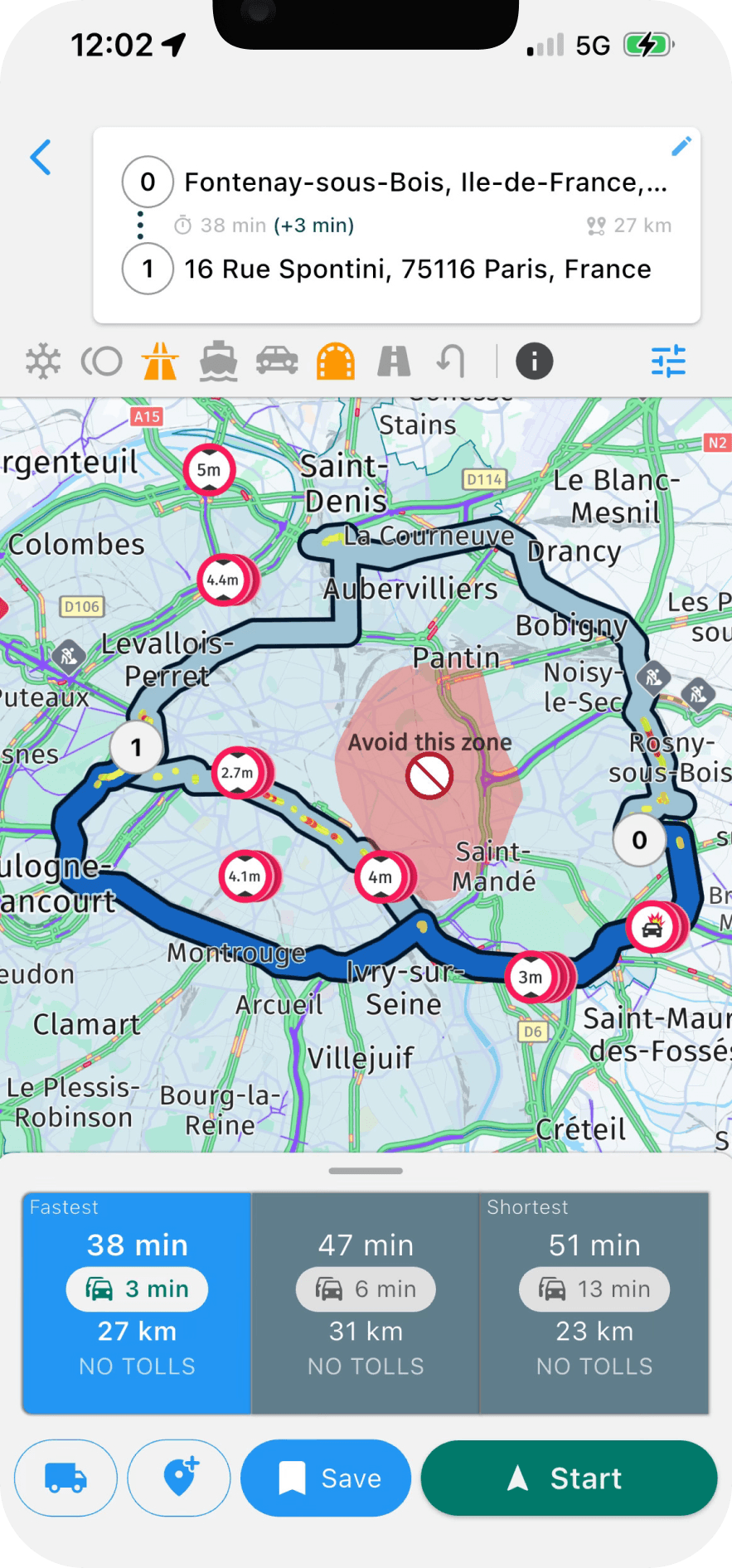
Picture the situation. You are not on a planned route. You are cruising through an unfamiliar industrial estate looking for a staging area, or you have taken a short detour to find a truck stop. Because you have not entered a destination, the sat nav is just a map — and around the next bend is a low-clearance bridge with a sign you have not seen yet.
This is the gap most navigation apps leave open. Consumer apps do nothing until you ask for directions. A truck GPS that only checks restrictions along an active route is safer, but it still switches off the moment you leave that route or never set one.
Reactive versus proactive
A standard GPS is reactive: it cares only about where you told it you are going. Navitruck's background alerts are proactive. As long as the app is running — in the foreground or in the background behind another app — it compares your position and heading with the restrictions ahead and warns you before you reach one that conflicts with your vehicle profile.
The alert does not depend on a route. It depends on three things: knowing where you are, knowing what your vehicle is, and knowing what is on the road ahead.
How the background alert works
- Position and heading. The app follows your position while it runs, so it knows which roads you are approaching, not just which one you are on.
- Your vehicle profile. Height, width, length, axles, gross weight, hazmat class and tunnel category are compared against each restriction. A 3.5 m van is not warned about a 4.2 m bridge; a 4.4 m trailer is.
- The restriction data. Low bridges, weight, width and length limits, hazmat bans and tunnel categories are stored with the map, so the check works offline too.
When there is a conflict, you get a sound and an on-screen warning early enough to stop or turn, not a note as you pass under the sign.
When off-route moments happen
Background alerts earn their place in exactly the situations where drivers are most exposed:
- Unscheduled detours. A closure pushes you onto side streets your plan never covered.
- The last mile. Searching for a specific dock, gate or parking bay in a tight, unfamiliar industrial zone.
- Short hops you know by heart. Moving between a yard and a customer across town, when it feels unnecessary to set a destination but the infrastructure is just as low.
More than a map
Turning the navigation app from a directions tool into a safety layer that stays on means your off-route moments are covered as well as your planned ones. It is not about finding the way — it is about never having to reverse out from under a bridge.