Hitch up a caravan and your car is suddenly around twelve metres long, close to three metres tall and well over two metres wide. Pick up a coachbuilt motorhome and you may be driving three and a half tonnes or more. Your phone's sat nav knows none of this. It plans the route it would plan for the car alone, and the places where that goes wrong are predictable.
Where a car route catches out a caravan or motorhome
- Narrow lanes and single-track roads. The shortest route to a campsite is often the narrowest. Fine in a hatchback, a real problem when you meet a tractor with a caravan behind you and no room to reverse.
- Low bridges and underpasses. Railway bridges on minor roads can be lower than a caravan with a roof aerial or a motorhome with air conditioning and solar panels on top.
- Weight-limited bridges and roads. Small bridges and some town roads carry weight limits that a car never notices and a heavy motorhome can exceed.
- Width restrictions. Bollards, width-restricted lanes and old town gates are set for cars.
- Tight turns and hairpins. The combined length of car and caravan decides whether you get round, not the length of the car.
What to put in the vehicle profile
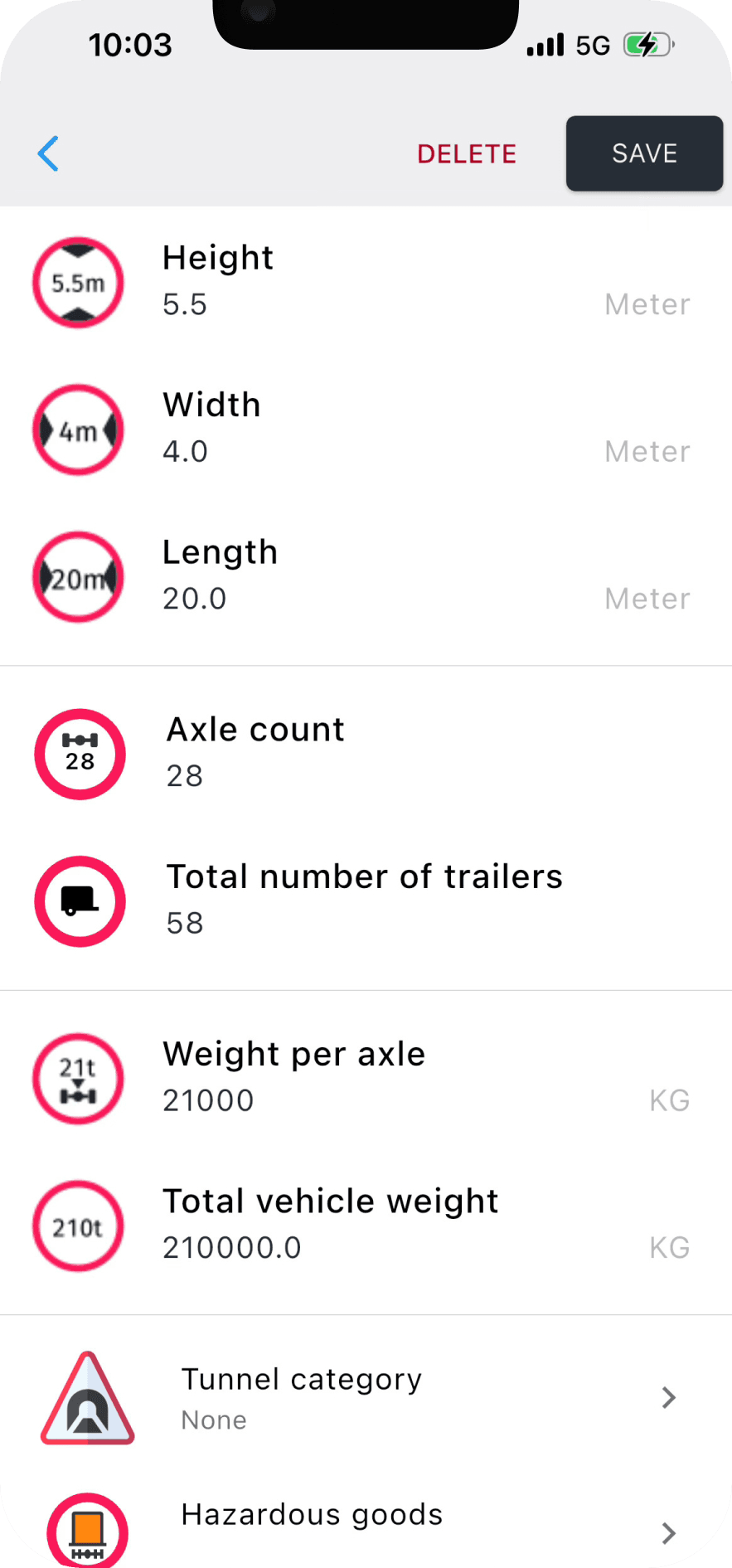
A caravan or motorhome profile is only useful if the numbers are right. Measure once, write them down, and enter them before your first trip.
- Height: the highest point of the outfit, including roof aerials, air conditioning, solar panels, roof boxes and bikes on the roof. Measure loaded and on level ground.
- Width: the widest point, usually the caravan body or towing mirrors.
- Length: car plus caravan from front bumper to rear of the caravan, including the A-frame and any bike rack; for a motorhome, include rear racks and a towed car if you tow one.
- Weight: for a motorhome, its maximum authorised mass from the plate; for a caravan outfit, the plated maximums of the car and caravan.
NaviTruck lets you keep several profiles, so you can switch between the car on its own and the car with the caravan in one tap. Do it before you set off, not at the first bridge sign.
The drives you don't plan
Most caravan and motorhome routes are planned: home to the site, site to the next site. The awkward moments tend to be the short drives in between, when nobody types in a destination: into the village for supplies, out to a viewpoint, round a diversion, finding the campsite entrance in the dark.
NaviTruck's background protection covers those too. With it switched on, the app notices when you start driving, even if it is closed, compares the road ahead with your profile and warns you on the lock screen before a low bridge, weight limit or width restriction you do not fit. One subscription includes it, along with offline maps for when the campsite has no signal, and Apple CarPlay and Android Auto.
Comparing apps
Not every truck sat nav has a proper caravan or motorhome profile, and some cap the size they accept. We compared the apps drivers use in the UK, Australia, the US and other countries, with sources for every claim.